Stiff or Sluggish? 4 Powerful Reflexes to Balance Your Fire Energy
A Simple Self-Care Technique to Support Movement, Energy & Vitality
Over the past several weeks, we’ve been exploring simple ways to support the Summer Fire Element.
We’ve learned to recognize the body’s signals, encourage energy flow with Meridian Tracing, and calm the nervous system with Neurovascular Reflexes.
Today, I’d like to introduce another technique that has been part of my personal practice and teaching for decades—Chapman Neurolymphatic Reflexes.
If you’ve ever felt stiff after a long car ride, sore after sitting at a computer, or simply sluggish after a day of too little movement, this simple technique may become one of your favorite self-care tools.
When Tenderness Became a Teacher
I still remember the first time someone introduced me to the Neurolymphatic Reflexes.
As they gently worked one of the reflex points, I flinched and could hardly believe how tender it felt.
My first thought was:
“Something must be wrong!”
Instead, my instructor smiled and said:
“Your lymphatic system is simply asking for movement.”
Within a minute, the tenderness began to fade. My muscles relaxed, and I felt lighter and surprisingly energized!
That experience changed the way I thought about tenderness.
Today, I see tenderness as information rather than something to fear. Sometimes a tender spot is simply an invitation to slow down, pay attention, and give your body some gentle movement and care.
A Brief History
These fascinating reflexes were originally identified by Dr. Frank Chapman, an osteopathic physician who described specific reflex points that appeared to correspond with particular organs and body systems.
Years later, Dr. George Goodheart, founder of Applied Kinesiology, incorporated Chapman’s discoveries into his work and referred to them as Neurolymphatic Reflexes.
These reflexes became part of the Applied Kinesiology approach to working with muscle function and the body’s reflex systems.
Today, Neurolymphatic Reflex techniques are used within a variety of complementary and bodywork approaches.
Why Movement Matters
Unlike the circulatory system, the lymphatic system doesn’t have a central pump like the heart. Lymph movement is supported by things such as:
🌿 Movement
🌿 Muscle activity
🌿 Massage
🌿 Deep breathing
When we spend long periods sitting or aren’t moving as much as usual, we may notice stiffness, muscle soreness, fatigue, heaviness, mild swelling, or reduced flexibility.
Movement is one of the simplest ways we can support our body’s natural rhythms and vitality.
Fire Element Neurolymphatic Reflexes
The Fire Element is associated with four major meridian systems: Heart, Triple Warmer, Small Intestine, and Pericardium.
There are several muscles associated with Fire Neurolymphatic Reflexes. For this article, I’m highlighting four major muscle associations.
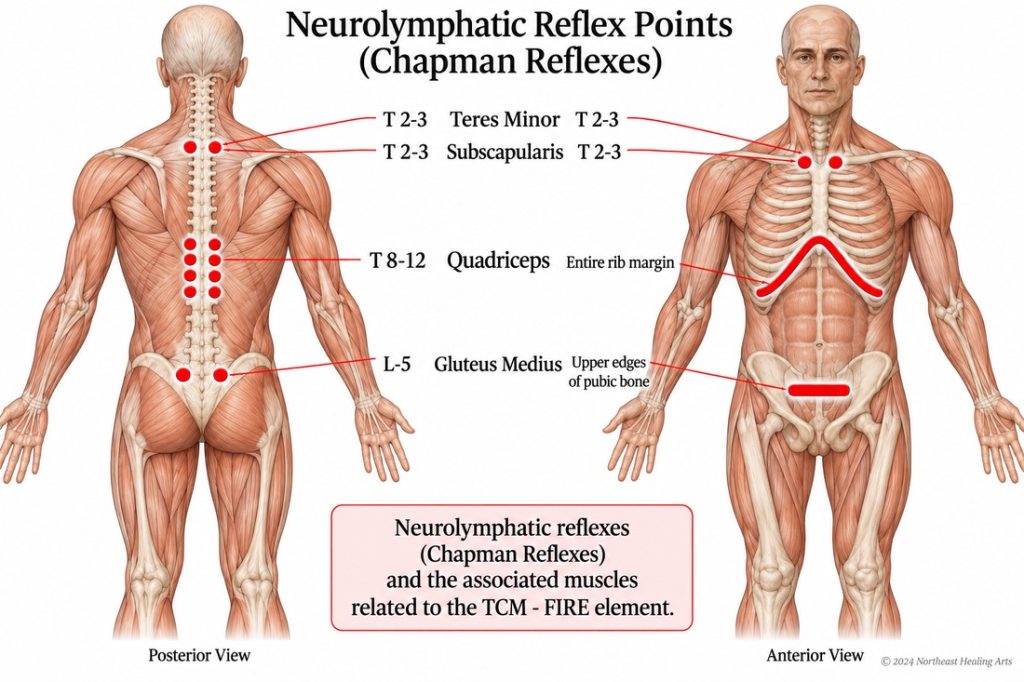
❤️ Heart Meridian — Subscapularis
Within the Touch for Health framework, an imbalance may be associated with:
- Palpitations
- Dizziness
- Shoulder or chest discomfort
- Bleeding gums
- Concerns related to circulation and fluid flow
❤️ Triple Warmer Meridian — Teres Minor
An imbalance may be associated with:
- Shoulder problems
- Thyroid-related concerns
- Digestive disturbances
- Infections
- Changes in weight
- Difficulty with metabolism and body temperature regulation
❤️ Small Intestine Meridian — Quadriceps
An imbalance may be associated with:
- Difficulty climbing stairs
- Difficulty getting up or down from a seated position
- Difficulty lifting the knee
- Kneecap or other knee problems
- Indigestion and intestinal cramping
❤️ Pericardium Meridian — Gluteus Medius
An imbalance may be associated with:
- A high hip or shoulder
- A tendency toward bowed legs or an unusual limp
- Menstrual cramps
- Prostate-related concerns
- Sexual difficulties
- Breast soreness
These associations come from the Applied Kinesiology framework and are not intended as medical diagnoses.
How to Work With Neurolymphatic Reflexes
Neurolymphatic Reflexes are located throughout the front and back of the body. They can generally be worked through clothing or directly on the skin.
You can massage the front reflexes with your fingertips or stimulate some of the back reflexes using two balls placed on either side of the spine.
For convenience, you may choose to work only the front points. If you’d like to work the back points, you can place two balls inside tube socks, drape the socks over your shoulders, and lean your back against a wall. Your body weight provides gentle pressure to the reflex points along each side of the spine.
Personally, I prefer lying on the floor. I can use my body weight to create just the right amount of pressure while gently scooting up and down or moving from side to side.
Tennis balls work well for many people. Lacrosse balls provide firmer pressure, while racquetballs may feel more comfortable if you prefer a gentler touch.
The goal isn’t to tolerate intense pain. These points may feel tender, but the pressure should remain comfortable and purposeful.
Typically, 20–30 seconds is enough to stimulate a point. You can certainly spend more time if you enjoy it, but at that point you’re moving more into the category of massage—which is wonderful too!
You can usually work through the Neurolymphatic Reflex points in about 5–10 minutes.
Start gently and let your body guide you.
Tenderness Is Information
People often ask me:
“Why is this point so sore?”
I simply tell them:
“Your body is communicating.”
When you discover a tender reflex point, rather than immediately assuming something is wrong, consider it an opportunity to pause and pay attention.
Gently work with the point and notice what happens. If it’s especially tender, spend a short amount of time there and come back to it later.
Your body is remarkably responsive.
Listen to it.
Support it.
Trust it.
Everyday Ways I Use Neurolymphatic Reflexes
I’ve used Neurolymphatic Reflexes as part of my own self-care for many years.
During long road trips, I usually bring my reflex balls along and, when I’m driving I use them against my back to work various bilateral reflex points. This keeps me relaxed, alert and I don’t feel dragged out when I reach my destination.
When my children were little and felt nauseous, I would gently massage reflex areas I associated with the Stomach meridian. As they grew older, I taught them where some of the front reflexes were located so they could help themselves when Mom wasn’t nearby.
Although these points aren’t part of the Fire Element, I also want to mention an area traditionally associated with the Large Intestine meridian. For those experiencing occasional bowel irregularity, gently massaging along the outer thighs in the area of the IT bands can be helpful.
When I’m feeling physically depleted, I sometimes massage the Triple Warmer reflexes across my upper chest as an energy booster technique. These simple techniques have been part of my family’s self-care toolbox for years.
In my SK Master Series 1 workshop, students learn much more about the Neurolymphatic Reflexes associated with 14 major organs and systems and how to incorporate these techniques into their practice.
A Healthy Reminder
One of the greatest lessons Energy Medicine has taught me is that the body loves movement.
Movement doesn’t have to mean an intense workout. Sometimes it’s simply:
🌿 Move your body.
🌿 Take a deep breath.
🌿 Drink some water.
🌿 Massage a tender reflex point.
🌿 Take a walk after dinner.
🌿 Stretch before bed.
🌿 Get up and move after sitting for a while.
Small things can make a difference in how we feel.
So the next time you discover a tender spot, don’t automatically think, “Something is wrong.”
Instead, pause.
Breathe.
Get curious.
Ask your body:
“What do you need right now?”
Sometimes the answer may be simple:
A little massage.
A little movement.
And, as always, a little love. 💜