A Gentle Technique to Help Calm Your Nervous System
Have you ever noticed how one thought, conversation, or upcoming event can set your whole body on edge?
Maybe you’re nervous about an important interview. Maybe you’re replaying a difficult conversation. Or perhaps you’re anticipating an interaction with someone who tends to leave you feeling drained.
Throughout this Summer Reset Series, we’ve explored simple ways to support balance within the TCM Fire Element, including Meridian Tracing and a quick 60-second reset.
Today, I’d like to introduce another technique I’ve used in my practice and teaching for many years: Neurovascular Reflex Holding, sometimes called the Bennett Reflexes.
This is one of my favorite techniques when emotional stress appears to be part of what the body is asking us to address.
And sometimes, we don’t just want to feel calmer right now.
We want to create a different response the next time.
A Little History
The Neurovascular Reflexes were originally identified by Dr. Terrence Bennett, who developed a system of reflex points, many located on the head, that he associated with circulation and specific organs.
Years later, Dr. George Goodheart, founder of Applied Kinesiology, incorporated Bennett’s work into his developing system. Neurovascular Reflexes became one of several approaches used within Applied Kinesiology.
The Fire Element Connection
As we’ve discussed earlier in this series, the Fire Element includes four meridian systems:
Heart • Pericardium • Small Intestine • Triple Warmer
Each is associated with different qualities of emotional balance and different ways we may experience stress.
Not every Fire Element imbalance is necessarily emotional. The body may indicate that it wants a structural, energetic, meridian-based, or other type of correction.
But I believe it’s always worth considering whether emotions are part of the picture.
Sometimes that emotional component is small. Sometimes it’s significant. When emotional stress is strongly involved, addressing it can be a valuable part of deeper work.
Here’s a simple way to think about some of the emotional qualities traditionally associated with the four Fire meridians:
| Meridian | When Balanced | When Under Stress |
| Heart | Joy, love, inner peace | Anxiety, restlessness, insomnia |
| Pericardium | Trust, compassion, connection | Feeling guarded, rejection, oversensitivity |
| Triple Warmer | Resilience, adaptability, feeling safe | Overwhelm, hypervigilance, fight-or-flight |
| Small Intestine | Clarity, discernment, confidence | Confusion, indecision, feeling scattered |
These qualities aren’t meant to be labels or diagnoses. Rather, they can offer another way of noticing what may be happening within us.
This is where I particularly enjoy using Neurovascular Reflexes.
Sometimes Emotions Are Key
Think about what happens when you’re anticipating something stressful.
Your breathing may become shallow. Your shoulders tighten. Your thoughts speed up. You may begin rehearsing everything that could go wrong.
Interestingly, when we’re stressed, many of us instinctively put our hands on our heads.
Think about the last time you were overwhelmed and held your head in your hands without even thinking about it.
Rather than fighting our thoughts or continuing to analyze the situation, we can intentionally use gentle touch, quiet breathing, and focused attention to create some space around what we’re experiencing.
For me, this is where the practice becomes especially interesting.
Release the Emotional Charge—Then Create Space for Something New
When working with emotional stress, I may begin by helping someone identify the emotional charge surrounding a situation.
Rather than continuing to talk about the story alone, I ask the person if they’re comfortable with me placing my hands on the associated reflex points while they continue to process the experience, either verbally or quietly in their mind.
After a few moments, I may ask:
How would you like to see yourself moving forward?
What would you like to feel?
How would you like to respond?
This shifts our attention from simply trying to move away from an uncomfortable experience to consciously creating a picture of how we’d like to experience ourselves instead.
Imagine the Job Interview
Let’s say you’re preparing for an important job interview.
You’re nervous. Your mind is racing. You’re imagining everything that could go wrong.
While holding the appropriate Neurovascular Reflexes, you might first acknowledge the anxiety and allow some of that emotional charge to soften.
Then imagine yourself walking into the interview.
You’re calm, present, and confident. Your shoulders are relaxed. You’re listening carefully. You’re comfortable being yourself.
You don’t have to know exactly how the interview will unfold.
You’re simply giving yourself a different possibility to rehearse.
How would I like to show up?
That’s a very different question from:
What if everything goes wrong?
Before a Challenging Person or Situation
This can be especially helpful for therapists and other practitioners who spend their days working with people.
Let’s be honest—not every interaction is easy.
Maybe it’s a challenging client, a difficult family member, a stressful meeting, a dental appointment, or a conversation you’ve been dreading.
Before an interaction like that, take a few quiet moments to hold the Neurovascular Reflexes.
Notice your own reaction.
What am I already carrying into this interaction?
Can you allow some of that emotional charge to soften?
Then ask yourself:
How do I want to show up?
Maybe you want to listen without absorbing everything, have compassion without taking on someone else’s emotions, and maintain clear boundaries.
The goal isn’t to change the other person.
It’s to change the way you enter the interaction.
How to Practice Neurovascular Reflex Holding
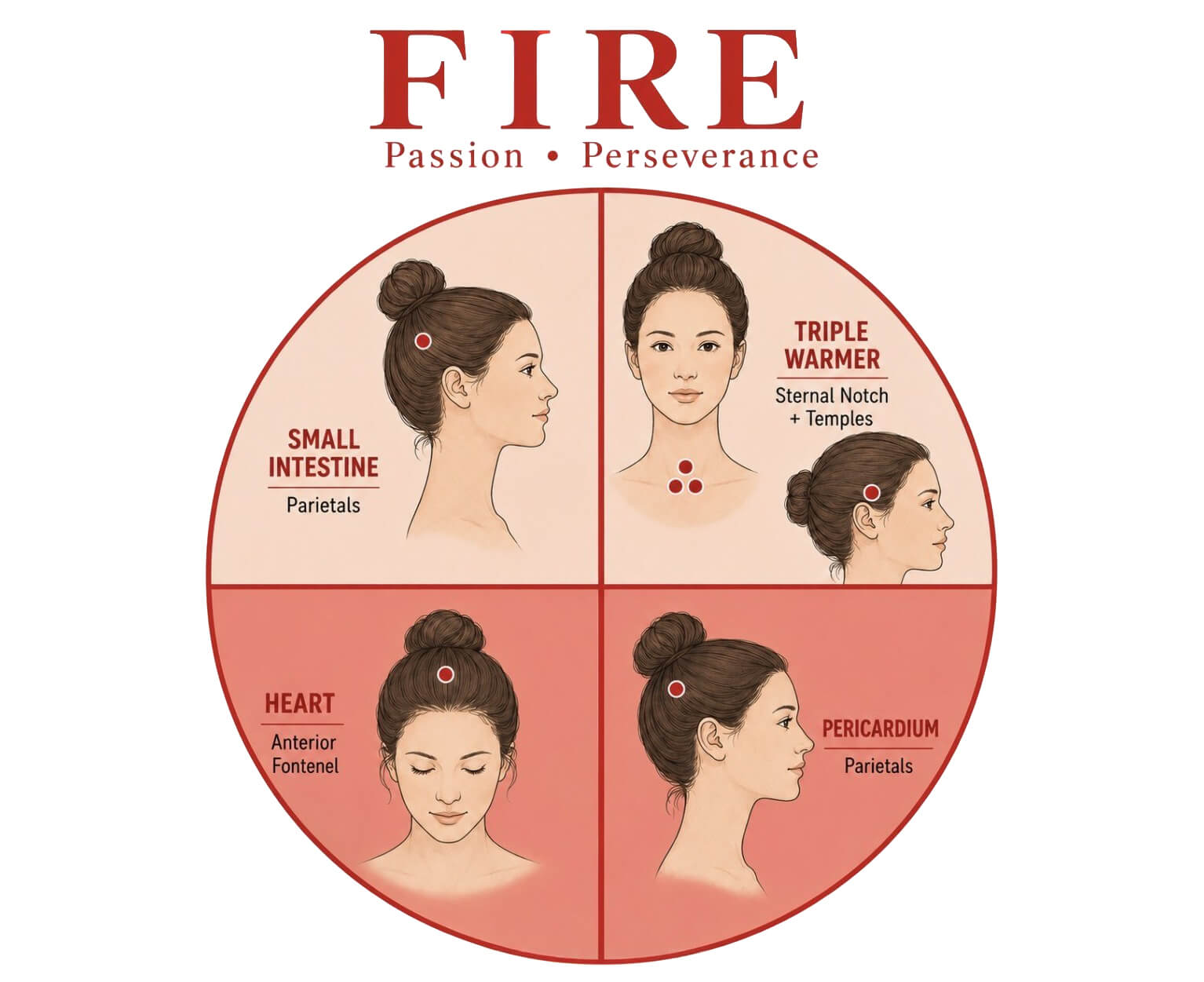
For this Summer Reset Series, I’m focusing specifically on the Neurovascular Reflexes associated with the four Fire Element meridian systems.
Find a comfortable seated or lying position. Using a very light butterfly touch, place your fingertips over the appropriate Neurovascular Reflex points shown in the accompanying diagram.
Then:
- Close your eyes if that feels comfortable and take a few slow breaths.
- Notice what you’re feeling without judging it.
- If there is emotional charge connected to a situation, person, or memory, acknowledge it and allow yourself to feel it.
- Imagine releasing some of the emotional charge and allowing those feelings to neutralize.
- Picture yourself embodying the qualities you want to bring to that situation—perhaps calm, confidence, patience, clarity, compassion, or healthy boundaries.
- Continue holding the points quietly as you breathe and imagine how you’d like to respond moving forward.
- You don’t have to follow a rigid sequence. You can work with individual points or combinations of points according to what you’re drawn to explore.
- Remember, you cannot change the past or control how other people will act, but you can work toward mitigating the negative impact those challenging situations have had on you.
- By envisioning a positive outcome and practicing how you’d like to respond, you can begin creating new neural pathways that support a different response.
A Simple Bedtime Reset
This technique can also be wonderful at the end of a busy day.
I’ve had nights when my body was exhausted, but as soon as my head hit the pillow, my mind started replaying conversations:
Did I forget something?
Why did I say that?
I should have asked about…
Instead of fighting those thoughts, try gently holding the Neurovascular Reflexes, closing your eyes, and taking a few slow breaths.
Let the day settle.
You don’t have to solve anything.
Simply give yourself a few quiet moments to let it all go.
A Final Thought
Sometimes we need to calm the mind or release an emotional charge.
And sometimes, once we’ve created a little space, we need to ask a different question:
How do I want to show up next time?
The next time you’re anticipating a difficult conversation, feeling anxious about an upcoming event, or carrying emotional residue from something that’s already happened, give yourself a few quiet moments.
Gentle touch.
Slow breathing.
Release what you don’t need to carry.
And then imagine the person you want to be on the other side of that experience.
That’s one of the ways I love working with the Neurovascular Reflexes—not by forcing change, but by creating space for a new response.
In the final article of this Summer Reset Series, we’ll explore another set reflexes related to the fire element: Chapman Neurolymphatic Reflexes—a different way of working with the body’s physical feedback and the organ and meridian systems associated with these reflexes.